Partners & News
How to Boost Your Metabolism: What Actually Works
Most metabolism advice is noise. Here is what actually moves the needle — muscle, protein, sleep, movement — and when a clinician-guided protocol becomes the missing piece.
Axis Metabolics · October 20, 2026 · 5 min read
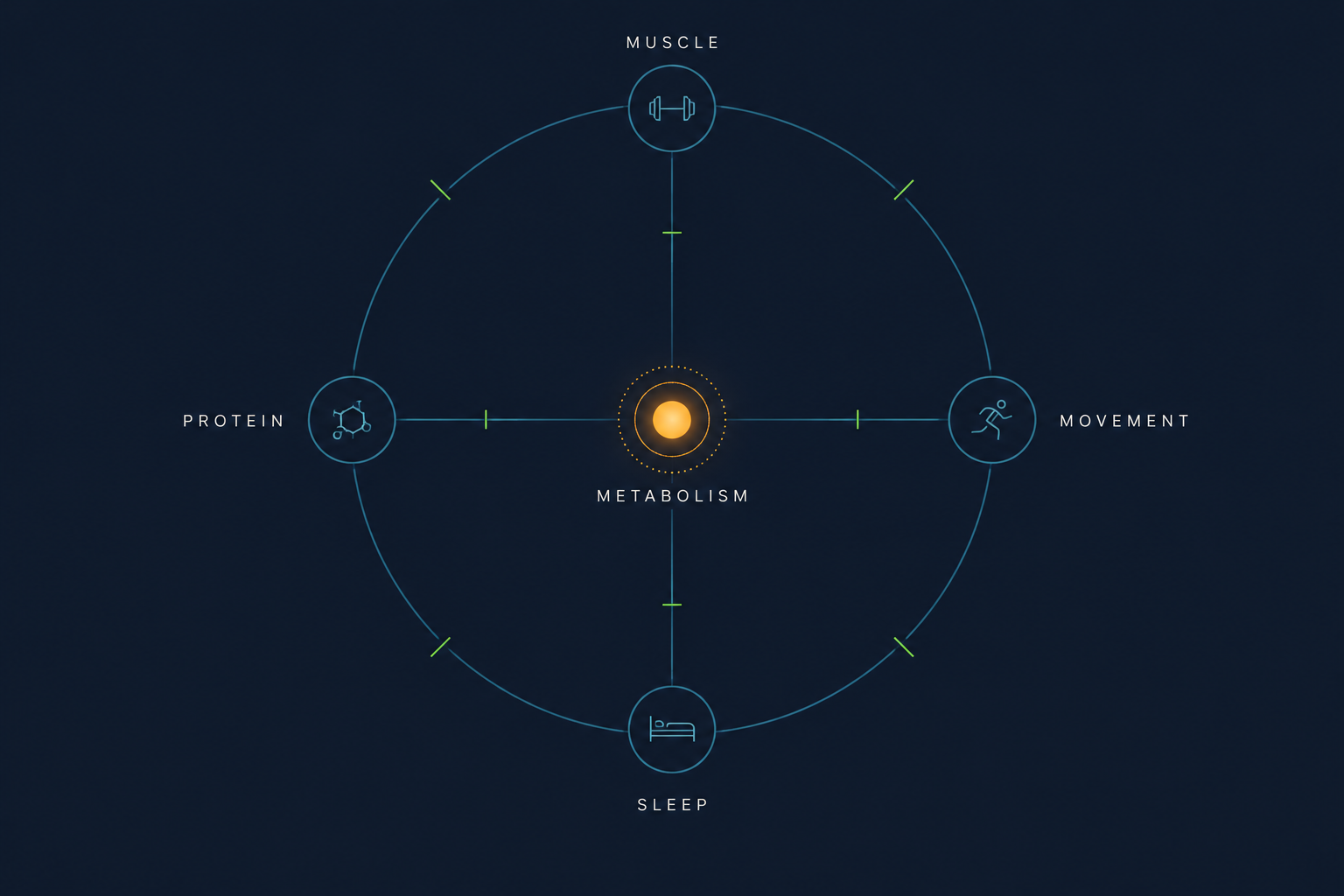
Search "how to boost your metabolism" and you will drown in advice: drink more green tea, eat six small meals, take this supplement, try that hack. Most of it is noise. Your metabolism is not a switch you flip with a superfood — it is the sum of how much energy your body burns at rest, how much you move, and how well your hormones are doing their jobs.
The good news: the things that genuinely move the needle are well understood. The better news: when the fundamentals are in place and something still is not responding, modern clinician-guided protocols can address the part willpower cannot.
1. Build muscle — it is your metabolic engine
Muscle tissue burns more energy at rest than fat tissue, and it is the primary site where your body clears glucose from the bloodstream. After about age 30, adults lose muscle steadily unless they actively fight it — and that loss is one of the biggest reasons metabolism "slows down" with age.
This is why resistance training sits at the top of the list — and it comes in more forms than most people realize. Traditional strength training with barbells and dumbbells works. So does functional fitness: boxing and kickboxing workouts, HIIT classes, kettlebell and athletic-conditioning formats, battle ropes, bodyweight training. What matters metabolically is that you are challenging your muscles progressively and consistently, two to four sessions per week — the format should be the one you actually enjoy enough to keep showing up for.
Whichever route you choose, building and keeping muscle does more for your resting metabolism than any supplement on the market. It is also why we say muscle is metabolic armor — the more you carry, the more resilient your metabolism becomes.
2. Eat enough protein — and enough food
Chronic under-eating is one of the most common metabolism killers we see. Severe restriction signals scarcity, and the body adapts by burning less. The goal is not a harsh diet — it is fuel.
Protein deserves special attention for three reasons: it costs more energy to digest than fat or carbohydrate, it protects lean muscle while you lose fat, and it keeps you full enough that consistency stops being a fight. A simple starting point most adults do well with: a palm-sized portion of quality protein at every meal.
3. Sleep like it matters — because it does
Even a few nights of short sleep measurably disrupts the hormones that regulate hunger and blood sugar. People who sleep poorly tend to eat more, crave worse, and recover slower — a triple hit to metabolic health. Seven to nine hours is not a luxury; it is infrastructure.
4. Move more outside the gym
The calories you burn in everyday movement — walking, stairs, standing, fidgeting — often outweigh what you burn in a workout. This "background burn" is one of the first things to drop when people diet or get busy, and one of the easiest levers to pull back up. A daily step goal you actually hit beats an ambitious one you abandon.
When the fundamentals are not enough
Here is the part most metabolism articles skip: sometimes you can do all of the above — train, eat well, sleep, move — and progress still stalls. That is often not a discipline problem. It is a biology problem.
Hormonal shifts, insulin resistance, and age-related changes in body composition can put a ceiling on what lifestyle alone accomplishes. This is exactly where clinician-guided optimization protocols come in — including the peptide protocols available through Axis Metabolics.
Where peptide protocols fit — and why "clinician-guided" matters
Peptides are short chains of amino acids — signaling molecules your body already uses — and modern protocols use them to support specific metabolic goals. Through Axis, visitors can explore medically available protocol categories such as:
- Metabolic and body-composition protocols — including GLP-1–based protocols that target appetite regulation and blood sugar, the most studied category in modern weight management
- Recovery and repair protocols — peptide protocols designed to support tissue repair, training recovery, and healthy inflammation response
- Longevity and vitality protocols — protocols aimed at cellular health, energy, and healthy aging
The words "clinician-guided" are doing real work in that sentence, and they are what separates a legitimate protocol from the grey market. Peptides sold online as "research chemicals" come with no medical review, no lab work, no verification of what is actually in the vial, and no one to call when something feels off. A clinician-guided protocol is the opposite of that:
- You choose the direction — you pick the protocol category that fits your goals and complete the intake and the lab work that protocol requires
- A licensed clinician reviews everything — your health history, your current medications, your lab results — and approves, adjusts, or declines. Not everyone is a candidate, and that is a feature, not a bug
- Pharmacy-grade sourcing — anything prescribed is fulfilled by U.S.-based licensed pharmacies, not a website with a disclaimer
- Ongoing oversight — the clinical team stays involved; a protocol is a managed plan, not a one-time transaction
Two more things matter as much as the category list. First, these are protocols, not hacks — each one is built to work alongside the training and nutrition foundation above, not instead of it. Second, there are no guarantees and no one-size-fits-all dosing — the clinician makes every determination after reviewing your history and labs. That is the point of having a real clinical team.
The Axis approach
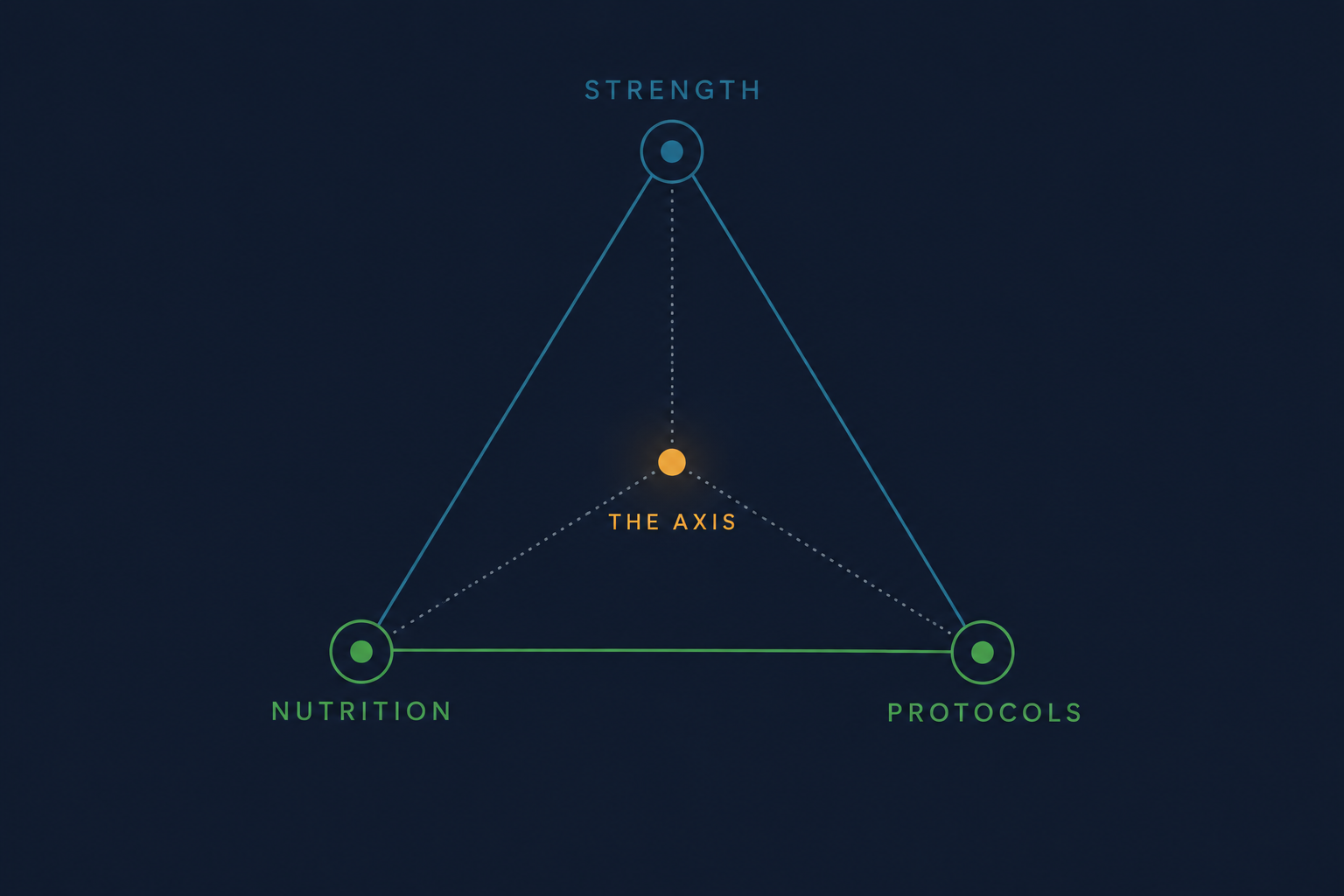
Everything above triangulates to a single idea we call The Axis: intentional training, real nutrition, and — when your biology needs it — clinician-guided optimization protocols, all pulling in the same direction. Remove any one of the three and the other two have to work twice as hard.
If you are not sure which piece is your missing piece, that is exactly what our protocol quiz is for. It takes a couple of minutes, and it points you toward the protocol direction worth discussing with a clinician.
Axis Metabolics is not a medical practice and does not provide medical advice. Prescriptions, when appropriate, are issued by independent licensed providers after reviewing your health history and lab work, and fulfilled by U.S.-based licensed pharmacies.
Not sure where to start?
Find your protocol
A 60-second quiz showing which protocols are worth discussing with a clinician.
Take the protocol quizTrain with a partner?
Claim your discount
Members and clients of our partner gyms, trainers, and coaches get a one-time discount on their clinical protocol.
Claim your discountKeep reading